Country: Australia
Location: Mt Druitt NSW
November 2019
The Hive Mt Druitt was initiated in 2014 using short-term funding from Family and Community Services (FACS) to two non-government organisations (Ten 20 and United Way). The goal was to develop a business case for a Collective Impact initiative in the area, motivated by data that indicates that:
- only 1 in 5 people in Mount Druitt complete high school, while less than 2 per cent achieve a tertiary qualification;
- nearly one-fifth of 15 – 24 year olds are disengaged from employment and education;
- adults are twice as likely to be unemployed (12 per cent) compared with Sydney (4.9 per cent) and NSW overall (5.2 per cent);
- individuals are four times as likely to be at risk of domestic assault.
Read More
In Mt Druitt there are hundreds of service providers who have a role in directly or indirectly supporting the development of children, yet there has been no overarching coordination mechanism. The HIVE aims to fill this gap by facilitating coordination and collaboration among local service providers, community members, government agencies, and businesses.
The HIVE is based on an understanding that simply adding more funding, services and programs is not the answer to improving the lives of children and families in Mt Druitt. It is necessary to understand why outcomes for children in Mt Druitt are still well below average, and find new ways of working together to make change happen.
Read More
The HIVE’s overall vision for Mt Druitt is “A thriving generation of children with diverse life opportunities.” Its five year goal as identified in March 2015 in a two-day workshop held with 74 local stakeholders is: All children in postcode 2770 start school well. To meet the goal The HIVE identified 20 interventions pathways that support 0-5 year olds to meet developmental milestones. These pathways are based on best practice identified in a literature review.
Read More
- The focus in 2014 was on scoping a Collective Impact initiative for children in Mt Druitt. This involved meeting with diverse local stakeholders, analysing existing quantitative and qualitative data, and writing a Business Case for the founding parties.
- The focus in 2015 was on co-designing the initiative with local stakeholders, which included conducting research with local families to understand the issues affecting local children. It was important the Hive initiative was developed in response to local conditions, which are best understood by those who live and/or work in the local community and to foster local ownership of the approach.
- The focus in 2016 was on introducing a community development initiative in Willmot and developing an initiative to improve enrolment, attendance and the quality of early childhood education and care (ECEC).
- The focus in 2017 was to kick start a conversation in Bidwill that got local services thinking about ways they could work together to engage families with young children. Since then that group has been working on engaging families with children under 5 years through Kids Days, and is getting to know families and what might be needed to better support them.
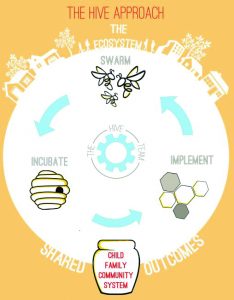
The HIVE’s approach draws on strengths based community work, co-design and collective impact methodologies. However, its core approach is a basic innovation cycle.
- Swarms bring a large and diverse group of people together at key points in the journey. They provide the opportunity to connect, share insights, identify priority areas for change, align work, and review progress.
- Incubation involves giving more focused attention to areas for collective action. A small and diverse working group is formed to research the relevant issues, causes and potential responses. The group considers baseline data, leading practice, research and local knowledge. The group agrees on a collective response designed for Mt Druitt.
- Implementation The HIVE scales, shares and spreads its success. Leadership for implementation transitions from The HIVE Team to whichever community groups or organisations are best placed to make change happen.
- The HIVE Team supports the process of working together. This can include hosting events, facilitation, communication and administration.
Read More
The Collective Impact approach used at The Hive offers a significant opportunity to guide the community and systems level change to ensure families and communities can thrive in Mt Druitt. The Hive uses a process of co-design, advocates for not duplicating existing services, and has diversified funding sources that allow it to take a long-term view, rather than base their work around funding cycles.
Drawing on research by the Australian Research Alliance for Children and Youth (ARACY), The Hive Leadership Group has identified 20 Result Areas for children pre-birth to 5 years of age. Systematic initiatives that respond to each Result Area across the 2770 postcode are being developed.
Read More
The Hive Team uses local achievements and lessons from its Suburb, Postcode and Systems level work to support learning and development across Australia and internationally. This includes participating in Collective Impact networks and communities of practice via presentations, workshops and publishing articles in social purpose sector media and via United Way’s global network or organisations in 40 countries.
The Hive is one of Opportunity Child’s six high-potential partner communities and:
- provides practical support to ‘backbone’ teams and community structures.
- uses its social innovation hub to help communities find solutions to complex issues.
- uses a helicopter view across Mt Druitt to take what is learned in and by communities, to advocate with ‘One Voice’ to drive systems change.

Read More
Danielle Roderick, Facilitator
hive@unitedway.com.au | 02 9628 8262
24 Anderson Avenue, Blackett NSW 2770
www.thehivemtdruitt.com
www.facebook.com/thehivemtdruitt

The Centre is committed to building cross-sector relationships and has a collective approach to health and social care. Learn about our Patrons.
 We acknowledge the traditional custodians of the land we live and work, the Bundjalung, Arakwal, Yaegl, Gumbaynggirr, Githabul, Dunghutti and Birpai Nationsand their continuing connection to land, sea and community. We pay our respects to elders past, present and future.