Country: Australia
Location: Hunter New England
January 2020
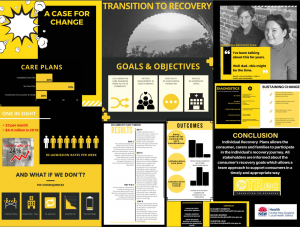
The Transition to Recovery project involves mental health users in planning and reviewing their care. It prioritises the preferences and values of the person with lived experience of mental health issues, their carers, families and kinship groups.
Read More
Feedback from the Mental Health Service consumer experience and staff surveys indicate that patients are leaving inpatient services with limited understanding of their goals for post-discharge care, and community mental health staff are not always aware of the transfer of care goals for clients referred from the inpatient service. Often these issues lead to avoidable readmissions or delayed discharge due to not having adequate support within the community.
Read More
- The Transition to Recovery project aims to increase collaborative care planning from acute hospital units to community mental health services and to improve the service experience of consumers, carer and families. It:
- Establishes clear mutual expectations with service users and carers about standards of service delivery
- Collaboratively identifies and addresses restraint and seclusion risks, and strategies for self-management and de-escalation
- Provides written material for the person (written in clear, understandable language) about relevant topics, such as medications, mental health issues, Aboriginal health issues, coping strategies and other support services.
Read More
Implementation includes:
- Process mapping sessions informed a thorough understanding of the challenges inhibiting the successful completion of care plans by clinicians with consumers.
- Diagnostics also included literature guided analytics, patient, carer, family and staff interviews, YES (Your Evaluation of Service) survey data, data analysis, literature guided analytics, and implementation capability audits.5
- Brainstorming groups, other workgroups and the Transition to Recovery (TRec) Steering Committee were convened to create and prioritise solutions, including:
- creating an integrative Individual Recovery Plan which includes all aspects of the person’s treatment plans, the person’s own recovery goals, needs of the family and carers. The Individual Recovery Plan is a live document that is to be used as reference point during the transition of care as well
- redesigning clinical review meetings to include patients, carers, families, and care coordinators in a meaningful and inclusive way.
Implementation success will be measured against:
- various performance indicators, including YES and Mental Health Carer Experience Survey results
- completed Individual recovery plans with patient
- carer, family and care-coordinator involvement
- re-admission rates as well as the average length of stay in an inpatient unit
- 48-hours follow up phone calls and acute post discharge community care
- seven day follow up on key performance indicators.
Read More
Lessons learnt thus far include:
- Significant confusion existed around the terms ‘Care Plan’, ‘Transition of Care Plan’, ‘Treatment Plan’ and ‘Discharge Plan’. The documents and terms are used interchangeably, and often in isolation. In this case, vital treatment information or person recovery needs can be omitted in the provision of care, as clinicians and carers do not consult the various documents.
- Diagnostics identified numerous issues and helped inform and prioritise the decisions around which areas to address.
- Key performance indicator data does not often reflect an accurate picture of what is happening on the ground. This required advice and ongoing action from Hunter New England Mental Health Service data manager through the TRec Steering Committee to help us understand how we can better measure quality transfer of care from inpatients to community services.
- Both inpatient and community staff want to change and create a better service for consumers, and felt empowered by the co-designing process followed, as they had the opportunity to share their experiences and concerns, but also create solutions.
- Obtaining the input of consumers and carers has proven more challenging due to the disenfranchised patient groups. The time required to engage with a valid consumer and carer sample, for a comprehensive, cross section of perspectives conflicted with project timeframes, so this has been built into plan-do-study-act cycles during implementation.
- Engagement with families and carers has been both confronting and encouraging, as we have learnt from their challenges and witnessed their despair as they try to navigate a system that is often inconsistent, all the while maintaining a sense of hope and optimism for their loved one and their future.
Read More
Implementation – The project is ready for implementation or is currently being implemented, piloted or tested.
Dates
January 2020 – December 2020
Implementation sites
Newcastle Mental Health, Hunter New England Mental Health, Hunter New England LHD
Partnerships
- Centre for Healthcare Redesign – presenters and support staff
- Professor John Wiggers – Director, Health Research and Translation and Population Health
- Consumer Participation Unit – Hunter New England Mental Health
- Flourish Australia – Newcastle
- Private medical professionals on steering committee

Read More
Elizabeth Roberts
Clinical Nurse Consultant
Newcastle Mental Health
Hunter New England Local Health District
Elizabeth.Roberts2@health.nsw.gov.au
Belinda Border
Service Design Lead
Hunter New England Mental Health
Hunter New England Local Health District
Belinda.Border@health.nsw.gov.au
Christine Love
Professional Lead – Peer Work
Hunter New England Mental Health
Hunter New England Local Health District

The Centre is committed to building cross-sector relationships and has a collective approach to health and social care. Learn about our Patrons.
 We acknowledge the traditional custodians of the land we live and work, the Bundjalung, Arakwal, Yaegl, Gumbaynggirr, Githabul, Dunghutti and Birpai Nationsand their continuing connection to land, sea and community. We pay our respects to elders past, present and future.